
Impressive Chion-in - Kyoto Impressions 👹🍣🎎 Wonderful Japan
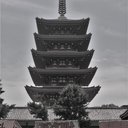

On our last trip to Kyoto, I mostly stuck to familiar paths and took my little team to places I’d been to before. For the kids, it was all new territory, and for me too—even though I’d seen a lot of it before—our outings were a really great experience. It’s actually a lot of fun to walk along those very same familiar paths and indulge a little in nostalgia and memories.
But in the end, I also happened to pass by a few places I didn’t know yet. Kyoto probably has plenty of them, but since we just rarely come here, we often stick to what we know and play it safe. But there’s actually so much to discover in the old imperial city—unfortunately, there’s just never enough time.
And when you say Kyoto, you’re thinking mainly of temples and palaces, though there are probably so many of the former that you could visit a different one every day of the year. And now that I’m checking up on this, it seems it would probably take more than five years to visit all the city’s temples this way. Though not all of them are likely to be as interesting as, for example, the Chion-in Temple, which we visited on a warm spring afternoon. Actually we just made it there and popped in for a quick look just before closing time.
Already the entrance area to this venerable temple is very impressive, as you will be greeted by the largest wooden gate in Japan.

The Sanmon gate of Chion-in was built in 1621 and stands approximately 24 meters tall. With its imposing wooden structure, massive pillars, and sweeping roof, you get a sense of the temple complex’s significance the moment one steps through it.
The gate itself not only serves a practical function as an entrance but also holds spiritual significance. In Buddhism, passing through a temple gate symbolizes the transition from the everyday world into a realm of contemplation and faith. The upper floor also houses numerous Buddhist figures and depictions of guardian deities, which we unfortunately were unable to see.
It is the long flight of steps leading directly to the gate that makes this Sanmon particularly impressive. If you step back a little further, the gate’s immense dimensions become even more apparent from a distance.

Right behind the gate, there are two staircases leading upward. The staircase on the left is steeper and is called Otoko-sakka. “Otoko” is the Japanese word for “man,” which already suggests that the climb might be a bit more strenuous. The staircase on the right is less steep and is called Onna-sakka. ‘Onna’ means “woman,” which explains the difference.

Well, I took the men's staircase, which wasn't really a challenge in the end. For anyone who's been up Mount Fuji, a staircase like that is a piece of cake 😊

As I mentioned, we arrived just before closing time and unfortunately only had time for a quick tour. But since we had made quite some effort to come here, I wanted to make the most of this short time.
Chion-in Temple itself is one of Japan’s most significant Buddhist temple complexes and is located at the foot of the Higashiyama Mountains in the eastern part of Kyoto. It is the main temple of the Jōdo School (the Pure Land School), one of the country’s largest Buddhist sects, and millions of believers and tourists visit the sprawling complex every year.
The temple’s history dates back to the 13th century, and it is said to have been built on the site where the Buddhist monk Hōnen spent the last years of his life. Hōnen taught that rebirth in Buddha’s Pure Land could be achieved through sincere faith and the repeated recitation of the Nembutsu, the invocation of Amida Buddha, and his teachings found great favor among the common people and spread rapidly throughout Japan.

Today, Chion-in is particularly impressive for its monumental buildings, such as the Sanmon Gate, which we’ve already seen, and the Miedo Hall. This hall is dedicated to the temple’s founder, Hōnen, and is one of the largest wooden structures in Japan.
Luckily, we had a few minutes to enter there as well, where as usual it was not permitted to take photos. But that gave me a chance to sit down and relax—I really like those brief moments of reflection.

And then the gates to the main hall closed behind us, and the temple complex began to empty out. I quickly took a short walk around and wanted to snap a few photos, since I probably wouldn't be back here anytime soon.

And the temple complex wasn't just spiritual, but also photogenic—which was probably due in part to its fantastic location here on the mountainside, whose lush greenery provided a wonderful, fresh backdrop. I would have loved to have walked just a little way into the mountains, but unfortunately there wasn't any time left for that.

But before I went outside, I turned around a few more times. The large hall is quite impressive, and on some days, it must get really crowded in here, which is probably quite a sight to see. But I was actually glad that it was fairly quiet and relaxed here on this late afternoon, and that we were able to make our way back at a leisurely pace.

And just like that, we were back at the massive entrance gate, whose sheer scale you really feel when you stand directly beneath it. Considering that this gate is over 400 years old, it has held up remarkably well, and we can only thank and congratulate both the old and new masters for the architectural masterpiece they created and preserved here.
We wanted to go on, because even though the temple was now closing behind us, the day was far from over. We still had a little way to walk but actually I wasn't in a hurry to get anywhere. Quite the opposite—I enjoyed being out and about, letting myself drift through this interesting part of the old imperial city of Kyoto, where there is so much to see everywhere.
And as I write these lines, I find myself starting to think about when I can come back to Kyoto again. It will probably be a while, but I’d love to set off right away tomorrow...


[//]:# (!worldmappin 35.00479 lat 135.78176 long Impressive Chion-in - Kyoto Impressions 👹🍣🎎 Wonderful Japan d3scr)
[//]:# (!pinmapple 35.00514 lat 135.78261 long d3scr)
You can check out this post and your own profile on the map. Be part of the Worldmappin Community and join our Discord Channel to get in touch with other travelers, ask questions or just be updated on our latest features.
Congratulations, your post has been added to the TravelFeed Map! 🎉🥳🌴
Did you know you have your own profile map?
And every post has their own map too!
Want to have your post on the map too?
- Go to TravelFeed Map
- Click the create pin button
- Drag the marker to where your post should be. Zoom in if needed or use the search bar (top right).
- Copy and paste the generated code in your post (any Hive frontend)
- Or login with Hive Keychain or Hivesigner and click "create post" to post to Hive directly from TravelFeed
- Congrats, your post is now on the map!
PS: You can import your previous Pinmapple posts to the TravelFeed map.Opt Out
I didn't know that Kyoto holds such important and historical subject like the "Choin-in"; Kyoto is a wonderful tourist destination. What I knew Kyoto for was the famous "Kyoto protocol" of 1997, where the treaty to save the environment from greenhouse effect was signed. Japan and Kyoto has offered a lot to the earth
Japan is a very beautiful country. I saw the blog you shared, and the beauty you showed us is truly inspiring. I love this country so much🇯🇵